skip to main |
skip to sidebar
by Ward Batty
 There are several reasons why two-player games are so appealing. First, you only need to round up one other person to play. Second, your chances of winning increases (in theory) to even. Most importantly, a two-player game is a more intimate experience, with the attention focused exclusively on your opponent's actions. This would seem to make playing such a game an ideal passtime for couples, but it can be hard to find a two-player game that works well. The classic two-player boardgames are, of course, chess, checkers and Go. Most of these are too confrontational and reward one type of thinking too much to be fun for both parties.
The good news for couples that enjoy games is that new games for two are being made available all the time. A nice feature of a number of these games is they are not as confrontational or as tactical as, for example, chess. Somebody will be better at the game, but there's enough of a luck factor so both players have a chance to win. So here are some recommendations of some two-player games that are especially good for couples. These are, of course, also well suited for any two players as well.
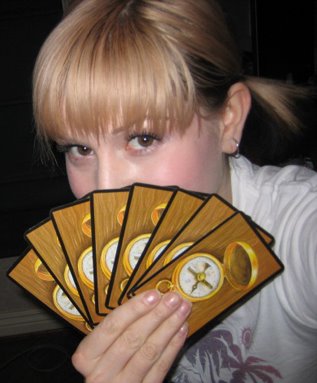
 First is Lost Cities by Reiner Knizia and published by Rio Grande Games. You might not think that a two-player game themed around jungle exploration would be a hit with the ladies, but it is. The core of the game play is something like competitive solitaire. All the players? melded cards are up, as are the top card in the discard stack for each suit, so there's lots of information available, and one crucial piece of information missing. In a favorite ploy of Mr. Knizia, which he utilizes in a number of his games including Lost Cities, players must play first and then draw a new card. Not knowing what that card will be really turns up the "game tension." The game unfolds with a bit more excitement and suspense than it would if players could draw the card before deciding what to play (the standard for most card games). You play through the deck only once, so the game lasts 15-30 minutes.
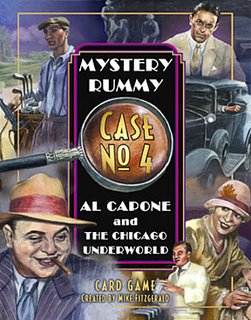
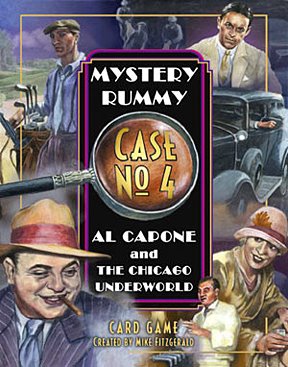
Another good game for couples is the Mystery Rummy series by Mike Fitzgerald and published by U.S. Games Systems. It might seem odd that a series of rummy games about Jack the Ripper, Jekyll and Hyde and the Murders in the Rue Morgue would have female appeal, but let's remember who watches CSI. In the case of Mystery Rummy: Jack the Ripper, players are trying to discover the true identity of the famous murderer. The game begins with a body and the scene of the crime. Evidence will accumulate in the form of melds, against one of the six suspects, but alibi and evidence cards can change the course of the investigation. Eventually, the Ripper is identified or escapes. Players score points for cards played. A game is played over several hands.
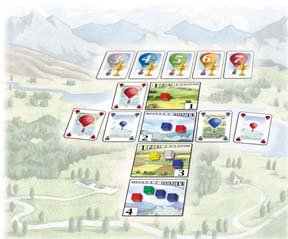 My final recommendation of a two-player game that's especially good for couples is Balloon Cup by Stephen Glenn and published by Rio Grande Games. This is an easy to learn game that has an appealing theme of air balloon races. Players play cards in an effort to win the colored cubed placed on each of five small boards. There are two twists that really "elevate" Balloon Cup (couldn't help myself). Depending on which side of each small board is face up, either the highest or lowest number combination of cards are needed to win, so both high and low cards are useful. The second twist is that players may play cards on their opponent's hand as well as their own. The first player to win enough colored cubes to claim three balloon cards is the winner.
These games should be available locally at a specialty game shop. Even if the shop doesn't have the game in stock, many are happy to special-order them. Your local store is a great place to learn more about these great games. Online, I'd suggest going to Google, click on Froogle and search for the game by name. For those in search of two player games that are more tactical and confrontational, I'll have some suggestions in a future column.
Photo credits. Lost Cities ©Betsy Ross, used with permission. Mystery Rummy ©U.S. Games Systems. Balloon Cup ©Rio Grande Games.
Ward Batty is a long-time game-player who has been with the same weekly game group for over twenty years. "I understood there was a pension." is his excuse. He writes a monthly column on the business of board games for Comics & Game Retailer magazine and has written articles and reviews for The Games Journal, Scrye, Knucklebones and Games International.
The Game Table is a weekly column which is self-syndicated by the author. If you would like to see this column in your local newspaper, please write the managing editor of the paper. Interested in carrying The Game Table in your paper, please contact Ward Batty.
 Welcome to The Game Table
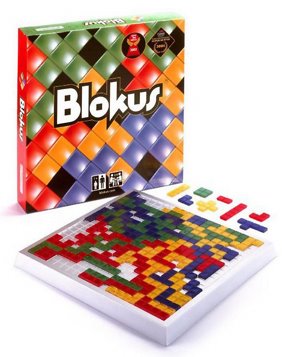
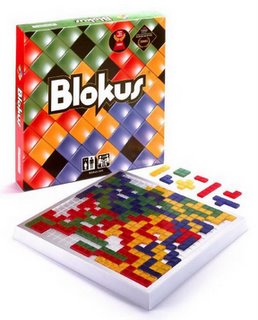
by Ward BattyAs unlikely as it may seem, during the ascendancy of the videogame, the humble boardgame has been experiencing a renaissance of its own. This may not be immediately apparent at the big box stores that carry boardgames, where Monopoly and Trivial Pursuit still reign. But there are hundreds of boardgame titles in print and dozens of new ones released each year for the specialty game store and online markets. And some are even making their way into such stores as Toys 'R' Us.These are called "designer games" because the game designer's name is featured, often prominently, on the box. Many of these games are co-published with European, mostly German, publishers. Several features distinguish these games: They are short, ranging from twenty to ninety minutes. Players are not generally eliminated from the game. There's also a sociability that is built into the games that increases the fun. Players compete against other players for victory points or to reach a goal. They rarely take directly from other players or send others backwards. There's lots of competition but much less conflict--which makes them a lot of fun to play.With this column I will have the honor of introducing many of these great games to a larger audience as well as cover some of the latest news and notes from the world of board and card games. I'll start off with two recommendations.Blokus, by Bernard Tavitian and published by Educational Insights, is easy to learn. It can be played at a high level of skill but is also fun for children as young as five. Blokus plays great for two to four players and is beautiful to look at. Players receive identical sets of pieces in their own color and with shapes that are familiar to any Tetris player. Pieces are laid starting in the player's corner and must touch their same-color pieces but only at the corners, no sides may touch. This rule applies only to each player's own pieces, so you can build next to opponents' pieces and squirt through at the corners. Not only is this a fun and challenging game that takes only about a half-hour, but also watching the board fill up into a colorful mosaic is also enjoyable.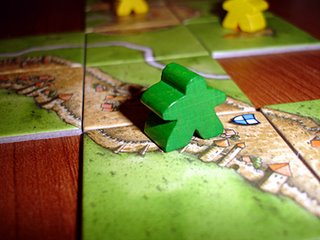 Carcassonne is a tile-laying game about building and populating the medieval city. The game begins with a single tile and through the course of the game tiles are added to create a complete game-board that is different every time. The turn is very simple, draw and play a tile. Any of four elements may be found on a tile. These are a green field, a road segment, a monastery or part of a walled city. Each player has seven "meeples" (miniature people) they place on a tile when they play it. The meeple is played on a specific element in that tile (on the road, for example) and scores when that element is completed. Players may not add a meeple directly to something that has a meeple. So one can't just add to someone else's road and hop on. Instead, one must build near what you want, then hope to draw a tile that makes the connection. Then both are in. Ties score equally for all players involved, so you want to get in on as many scoring opportunities as possible. But with only seven meeples to place, players must manage where they place so they can get some to score and become available to be placed again. The game generally takes about 45 minutes to play. Carcassonne scales great from two to five players and costs only about $20. Carcassonne is by Klaus-Jurgen Wrede and published by Rio Grande Games.To find these games locally, look for a specialty game shop. Even if they don't have the game in stock, they should be happy to order it. If you have a local store that carries the game, I'd suggest getting it there. With shipping the price won't be that much cheaper online and at the store you can look over some of the other great boardgames that are available and even get suggestions from the helpful folks there. Online, I'd suggest going to Google, click on Froogle and search for the game by name.
Photo credits. Blokus ©Educational Insights. Carcassonne ©Robert Hawkins. Used with permission.
Ward Batty is a long-time game-player who has been with the same weekly game group for over twenty years. "I understood there was a pension." is his excuse. He writes a monthly column on the business of board games for Comics & Game Retailer magazine and has written articles and reviews for The Games Journal, Scrye, Knucklebones and Games International.
The Game Table is a weekly column which is self-syndicated by the author. If you would like to see this column in your local newspaper, please write the managing editor of the paper. Interested in carrying The Game Table in your paper, please contact Ward Batty.
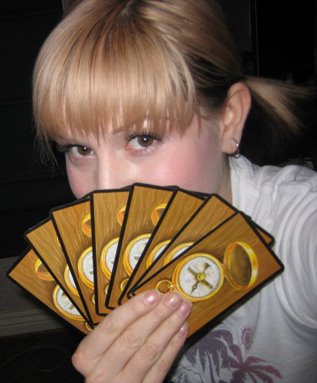 There are several reasons why two-player games are so appealing. First, you only need to round up one other person to play. Second, your chances of winning increases (in theory) to even. Most importantly, a two-player game is a more intimate experience, with the attention focused exclusively on your opponent's actions. This would seem to make playing such a game an ideal passtime for couples, but it can be hard to find a two-player game that works well. The classic two-player boardgames are, of course, chess, checkers and Go. Most of these are too confrontational and reward one type of thinking too much to be fun for both parties.
 First is Lost Cities by Reiner Knizia and published by Rio Grande Games. You might not think that a two-player game themed around jungle exploration would be a hit with the ladies, but it is. The core of the game play is something like competitive solitaire. All the players? melded cards are up, as are the top card in the discard stack for each suit, so there's lots of information available, and one crucial piece of information missing. In a favorite ploy of Mr. Knizia, which he utilizes in a number of his games including Lost Cities, players must play first and then draw a new card. Not knowing what that card will be really turns up the "game tension." The game unfolds with a bit more excitement and suspense than it would if players could draw the card before deciding what to play (the standard for most card games). You play through the deck only once, so the game lasts 15-30 minutes.
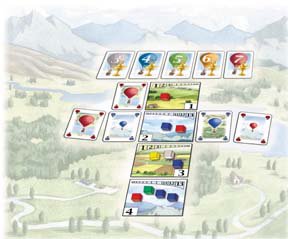 My final recommendation of a two-player game that's especially good for couples is Balloon Cup by Stephen Glenn and published by Rio Grande Games. This is an easy to learn game that has an appealing theme of air balloon races. Players play cards in an effort to win the colored cubed placed on each of five small boards. There are two twists that really "elevate" Balloon Cup (couldn't help myself). Depending on which side of each small board is face up, either the highest or lowest number combination of cards are needed to win, so both high and low cards are useful. The second twist is that players may play cards on their opponent's hand as well as their own. The first player to win enough colored cubes to claim three balloon cards is the winner.