My first column for The Boise Weekly was a year ago and covered my favorite six games of the 2006. That makes this the second annual year's best games list, this time for 2007. Games are listed alphabetically and for the purposes of this column I'm using the North American release dates.
Alchemist
Designed By: Carlo A. Rossi
Published By: Mayfair Games
This is a very interesting game which is, in theory, about making magic potions but is in reality a very interesting market game about making and selling different colored cubes. Creating a game about buying and selling with a viable market can be a tricky task, and Alchemist takes a clever and novel approach that makes for a very nice game.
Arkadia
Designed By: Rüdiger Dorn
Published By: Rio Grande Games
This is my favorite game of 2007. Players place buildings and surround those with workers that collect colored coins when the building is completed. This allows the player to adjust the market. The coins are worth how many you have to sell multiplied by how many of that color are visible in the central market.
Can't Stop
Designed By: Sid Sackson
Published By: Face 2 Face Games
Can't Stop is a classic dice game that was out of print for too long. This is a great game of pushing your luck, maybe the best of these type games. Can't Stop is a great game for kids and adults. Players roll four dice until they have three numbers they must roll each time. Progress from previous rolls is saved ... if you stop. Can you? There's a great online version called Roll or Don't available at http://www.rollordont.com/
Notre Dame
Designed By: Stefan Feld
Published By: Rio Grande Games
A novel game where each player tries to improve their section of Paris, support the building of Notre Dame and keep the plague-riddled rats at bay. It uses a great card-drafting system that originated in Magic the Gathering tournaments but has not been applied much to other games. Players take three cards, keep one and pass the other two to the player on your left. Then pick one of the two cards that have been passed to you and pass the other card. And keep the third card, so you end up with three cards from three players. Two of these will be played.
Portobello Market
Designed By: Thomas Odenhoven
Published By: Playroom Entertainment
A favorite type of game for me is a shortish game with tough decisions, a "meaty filler" as I call them, and even though there are no mushrooms in Portobello Market (it is a famous market in Britain) this is still an appetizing game. Players are building stalls in the market, trying to build in the most profitable locations. You can only build near where the bobby stands, but for money he will move wherever you want him to.
Zooloretto
Designed By: Michael Schacht
Published By: Rio Grande Games
This was named the Game of the Year in Germany and it is easy to see why. Players each have a zoo. Players fill trucks with up to three animal tiles and players select from these trucks. If there is room for the animal in your zoo that's great, but once you run out of space, animals are placed in the barn where they count negative points at the end of the game. This is a nice set-collection game with a theme that gives it universal appeal.
Saturday, March 08, 2008


Tuesday, January 08, 2008
Report from Essen--Prices Rising
This report originally appeared in ICv2 Guide #49--Games. We reprint it here, with space for more images. Editor and writer Ward Batty, who has over 30 years experience in retail management and publishing, sent us this report from the recently completed game fair in Essen, Germany.
Thursday, November 08, 2007
Four Days In The Center Of The Board Game Universe
I wrote an article about the recent The Essen Internationale Spieltage for Gamasutra that you might enjoy. This is a site for electronic game developers, but as games like Puerto Rico, Settlers and Carcassonne move to that format, there is increasing interest in what's happing at Essen.
Thursday, July 26, 2007
Boise Weekly
As a freelance writer, one never knows where where work may come from. A case in point, I've been writing for the Boise Weekly. You can read my reviews here.
Tuesday, January 02, 2007
Top Six Board Games for 2006
By Ward Batty
Say "games" and most think of video or online computer gaming, but the humble board game continues to not only hold its own, but also grow and thrive. After a slow start, 2006 has shaped up as a good year for board and card games. Here's a half-dozen games worth checking out.
In Leonardo daVinci (Mayfair Games, $45), players each have their own Renaissance-era laboratories and are competing to be the first to complete experiments. Experiments require a combination of materials and time devoted to research. Each turn, players assign a worker or workers to a particular task, such as upgrading your lab (you can even add a robot to help with the work) or getting a needed material. This is a novel game that may seem intimidating at first, but after a move or two the game falls together in a most satisfying manner.
Many trivia games are releases each year and most are dreadful. So I am pleased to report that Wits and Wagers (North Star Games, $29.99) is a novel twist and a lot of fun, even for non-trivia buffs. Players bet on other’s answers, so educated guesses, hitting the jackpot on long odds or knowing the interests of your friends and family can all pay off. The game can be taught in two minutes and takes only twenty to play.
Aquadukt (Uberplay, $27.99) is a shorter game, about 30 minutes to play, that combines a nice balance of strategy and luck. Players have tiles with houses they want to place near water. Houses that are next to water at the end of the game score for their owners, but there is a risk that the region will fill too soon and houses without water are removed. Players may place up to three tiles with houses, place a spring or extend an aqueduct.
Buccaneer (Rio Grande Games, $24.95) is a fun game of recruiting pirate crews. Players have discs with their pirate crew with values from 2-5. Players can recruit another players' crew by stacking one of their discs on top of a single disk or even a stack of discs. Different ships require different numbers of crew discs before the can set sail. When your stack is the right size, you can set sail and collect booty, but this must be shared with the crewmembers belonging to the other players.
My favorite two-player game of the year is Medici Vs. Strozzi (Rio Grande Games, $22.95). Players are traders who want to fill their boats with the most valuable cargo. Competing over three ports, the highest value load pays a nice bonus, but players also want to deliver particular types of goods to particular ports.
Winners Circle (Face to Face Games, $35) captures the fun and excitement of a day at the track without the traffic and smells. Players secretly bet on three horses and then take turns moving them, so there is no small amount of self-interest at work in terms of wanting a horse to go fast or slow based on how they bet.
Say "games" and most think of video or online computer gaming, but the humble board game continues to not only hold its own, but also grow and thrive. After a slow start, 2006 has shaped up as a good year for board and card games. Here's a half-dozen games worth checking out.
In Leonardo daVinci (Mayfair Games, $45), players each have their own Renaissance-era laboratories and are competing to be the first to complete experiments. Experiments require a combination of materials and time devoted to research. Each turn, players assign a worker or workers to a particular task, such as upgrading your lab (you can even add a robot to help with the work) or getting a needed material. This is a novel game that may seem intimidating at first, but after a move or two the game falls together in a most satisfying manner.
Many trivia games are releases each year and most are dreadful. So I am pleased to report that Wits and Wagers (North Star Games, $29.99) is a novel twist and a lot of fun, even for non-trivia buffs. Players bet on other’s answers, so educated guesses, hitting the jackpot on long odds or knowing the interests of your friends and family can all pay off. The game can be taught in two minutes and takes only twenty to play.
Aquadukt (Uberplay, $27.99) is a shorter game, about 30 minutes to play, that combines a nice balance of strategy and luck. Players have tiles with houses they want to place near water. Houses that are next to water at the end of the game score for their owners, but there is a risk that the region will fill too soon and houses without water are removed. Players may place up to three tiles with houses, place a spring or extend an aqueduct.
Buccaneer (Rio Grande Games, $24.95) is a fun game of recruiting pirate crews. Players have discs with their pirate crew with values from 2-5. Players can recruit another players' crew by stacking one of their discs on top of a single disk or even a stack of discs. Different ships require different numbers of crew discs before the can set sail. When your stack is the right size, you can set sail and collect booty, but this must be shared with the crewmembers belonging to the other players.
My favorite two-player game of the year is Medici Vs. Strozzi (Rio Grande Games, $22.95). Players are traders who want to fill their boats with the most valuable cargo. Competing over three ports, the highest value load pays a nice bonus, but players also want to deliver particular types of goods to particular ports.
Winners Circle (Face to Face Games, $35) captures the fun and excitement of a day at the track without the traffic and smells. Players secretly bet on three horses and then take turns moving them, so there is no small amount of self-interest at work in terms of wanting a horse to go fast or slow based on how they bet.
Sunday, November 19, 2006
Players Get a New Flavor of Catan in Elasund
Elasund: First City of Catan
by Klaus Teuber
published by Mayfair Games
$49.00
2-4 Players
Ages 10+
Game length 60-90 minutes
Review by Ward Batty
Many years after the release of Settlers of Catan, the line is still going strong. Last year saw the release of Candamir: The First Settlers and it has been followed this year with the release of Elasund: First City of Catan. This time players are building up the city of Elasund. Players place cubes on the buildings they erect, they also may place cubes on some of the sections of the city wall that they construct as well as on their contributions to the city church. Players also get the chance to place cubes when they build on the board spaces with windmills. The first player to place ten cubes is the winner.
The biggest change in terms of game play is that, as with Candamir, Elasund is played on a 12 x 12 grid. Players still roll dice for production each turn, but this time the rows are numbered and players with a building on that row that is a production building will receive either gold or an influence card when that number is rolled. On their turn, players may build one or two buildings, and then they may place a building permit. The building permits are tokens numbered zero to four and must be placed before a player can build. Finally, players may spend influence cards to do one of four bonus actions such as moving or upgrading a building permit.
Each player starts with two buildings on the board. They have two additional buildings they can place, and there are a number of neutral buildings ranging from one to six spaces large. These require a certain number of building permits as well as gold. Unlike most boardgames from Europe, Elasund has a bit more of a "gotcha" element. Buildings require a number of building permits, but it doesn't specify whose permits are used. As long as you have at least one permit down and it is numerically superior to each other player's tokens, you may build. You must pay the players the cost of their permits, but if you have the coin, away they go. It is also possible to displace buildings that are the same size, for a cost of influence cards, or smaller buildings for free. Any cubes on those buildings are returned to their owner, so victory points on the board can be displaced, which is something unusual.
In theory the game takes 60 minutes to play, my experience has been more like 90 minutes. There is no trading, so turns should be pretty straightforward. But when it is possible to displace cubes of the leading player it seems to make the game run longer.
I'm a huge fan of the original Settlers of Catan. Most of the spin-off games are OK to me, but run enough longer that in the end I'd rather just play two games of regular Settlers. Elasund is my favorite new Catan game since the original, especially if the game playing time shortens to the promised hour. But even at 90 minutes, this game provides interesting decisions, unfolds nicely and the ability to displace cubes or be displaced certainly increase the game tension in a good way. There are also different paths to victory, which is always a good thing.
In a groundbreaking move, Mr. Teuber has a great site that includes demos of his games. To see a demo and get more of a sense of the rules of Elasund: First City of Catan, visit profeasy.com.
Author's note: This review originally appeared in Scrye magazine.
Ward Batty is a long-time game-player who has been with the same weekly game group for over twenty years. "I understood there was a pension." is his excuse. He writes a monthly column on the business of board games for Comics & Game Retailer magazine and has written articles and reviews for The Games Journal, Scrye, Knucklebones and Games International.
by Klaus Teuber
published by Mayfair Games
$49.00
2-4 Players
Ages 10+
Game length 60-90 minutes
Review by Ward Batty
Many years after the release of Settlers of Catan, the line is still going strong. Last year saw the release of Candamir: The First Settlers and it has been followed this year with the release of Elasund: First City of Catan. This time players are building up the city of Elasund. Players place cubes on the buildings they erect, they also may place cubes on some of the sections of the city wall that they construct as well as on their contributions to the city church. Players also get the chance to place cubes when they build on the board spaces with windmills. The first player to place ten cubes is the winner.
The biggest change in terms of game play is that, as with Candamir, Elasund is played on a 12 x 12 grid. Players still roll dice for production each turn, but this time the rows are numbered and players with a building on that row that is a production building will receive either gold or an influence card when that number is rolled. On their turn, players may build one or two buildings, and then they may place a building permit. The building permits are tokens numbered zero to four and must be placed before a player can build. Finally, players may spend influence cards to do one of four bonus actions such as moving or upgrading a building permit.
Each player starts with two buildings on the board. They have two additional buildings they can place, and there are a number of neutral buildings ranging from one to six spaces large. These require a certain number of building permits as well as gold. Unlike most boardgames from Europe, Elasund has a bit more of a "gotcha" element. Buildings require a number of building permits, but it doesn't specify whose permits are used. As long as you have at least one permit down and it is numerically superior to each other player's tokens, you may build. You must pay the players the cost of their permits, but if you have the coin, away they go. It is also possible to displace buildings that are the same size, for a cost of influence cards, or smaller buildings for free. Any cubes on those buildings are returned to their owner, so victory points on the board can be displaced, which is something unusual.
In theory the game takes 60 minutes to play, my experience has been more like 90 minutes. There is no trading, so turns should be pretty straightforward. But when it is possible to displace cubes of the leading player it seems to make the game run longer.
I'm a huge fan of the original Settlers of Catan. Most of the spin-off games are OK to me, but run enough longer that in the end I'd rather just play two games of regular Settlers. Elasund is my favorite new Catan game since the original, especially if the game playing time shortens to the promised hour. But even at 90 minutes, this game provides interesting decisions, unfolds nicely and the ability to displace cubes or be displaced certainly increase the game tension in a good way. There are also different paths to victory, which is always a good thing.
In a groundbreaking move, Mr. Teuber has a great site that includes demos of his games. To see a demo and get more of a sense of the rules of Elasund: First City of Catan, visit profeasy.com.
Author's note: This review originally appeared in Scrye magazine.
Ward Batty is a long-time game-player who has been with the same weekly game group for over twenty years. "I understood there was a pension." is his excuse. He writes a monthly column on the business of board games for Comics & Game Retailer magazine and has written articles and reviews for The Games Journal, Scrye, Knucklebones and Games International.
Friday, September 01, 2006
The Life and Times of Alan R. Moon
My apologies for not doing a column in a while. I just posted a lengthy profile on game designer Alan R. Moon from last year. You can read it here at Boardgamenews.com.
I hope you enjoy it.
I hope you enjoy it.
Thursday, June 08, 2006
Let's Have a Party Game
 By Ward Batty
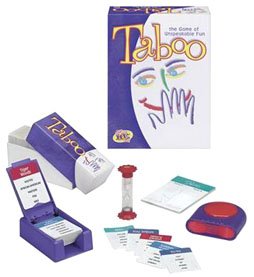
It was pointed out to me that I have neglected party games in this column so far. I like party games, sometimes a party game is just the thing, and so it is not through any prejudice on my part. One of the best party games is available at most department stores that carries games, Taboo by Brian Hersch and published by Hasbro. In Taboo, one player tries to get their partner to say a word on the card drawn, but not use any of the five words that one would commonly use that are also on the card. So, for example, a player must get their partner to say "diaper" without using the words smelly, cloth, disposable, baby or rash. A player from an opposing team can see the card and has a buzzer to sound if any word from the card is used in the descriptions. Taboo is fast and fun and can be played equally well by players of different ages and talents. I'm told the electronic version is also good but must admit to not having tried it.
 Another great party game is Times Up! by Peter Sarrett and published by R&R Games. Based on the parlor game Celebrities, the game has hundreds of cards with names of famous actors, politicians, writers, and fictional characters. The game is played in partnerships and lasts three rounds. In the first round, players get their partner to name the person by describing the person and the partner must keep guessing until they get the answer. Players have a 30 second timer and collect the cards their partner successfully names. Using the same clues, the second round allows players to say only one word and the partner only one guess. The third round is played like charades, no words, only gestures and humming or sound effects. The game is always hilarious, especially as the people on the card get boiled down to a single name and gesture. Invariably, you'll get a weird combination of names that will create hilarity, like Lou Abbot and Stan Laurel.
 Another great party game is Password. Not your idea of a typical party game, you say. It is important to note that Password can be played from any position, sitting, standing, and laying down... Of course, you don't need anything to play Charades or a favorite of mine, the dictionary game. Find a word in the dictionary that nobody knows the definition, then have folks writes down a made up definition and then everyone votes for their favorites. The person who looked up the word is the reader of fake definitions.
Author's note: This column will no longer be weekly.
Ward Batty is a long-time game-player who has been with the same weekly game group for over twenty years. "I understood there was a pension." is his excuse. He writes a monthly column on the business of board games for Comics & Game Retailer magazine and has written articles and reviews for The Games Journal, Scrye, Knucklebones and Games International.
The Game Table is a column which is self-syndicated by the author. If you would like to see this column in your local newspaper, please write the managing editor of the paper. Interested in carrying The Game Table in your paper, please contact Ward Batty
Wednesday, May 17, 2006
Fourteen Things I Like About Louis
By Ward Batty
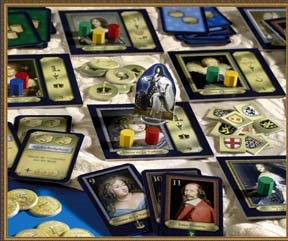
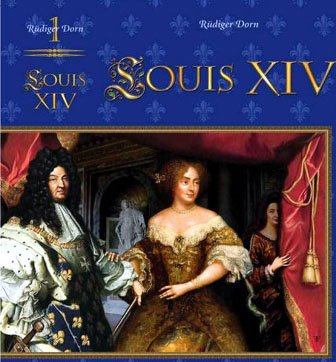
For those who have been pining for the next game they will want to play again and again, I am pleased to report that we have just that in Louis XIV by Rudiger Dorn and published by Rio Grande Games. The goal of the game is pretty simple. Players draw mission cards, which require two tokens to be fulfilled, and can then be placed face up and gives the player an additional ability. Missions cards come in three levels of difficulty to fulfill, but are all worth five victory points at the end of the game. The reason to go for a more difficult card is that it should be of more use during the coarse of the game.
Players accumulate the tokens they need to fulfill their cards by placing influence markers. A clever element of Louis XIV is the game board. It consists of twelve square boards, arranged on the diagonal to form a 5x5 checkerboard (including spaces). The boards feature members of Louis XIV's court.
The game is played over four rounds with four phases in each round. First players receive income and the King Louis figure is placed on a character board. Players are dealt five cards that each match one of the character boards. Players either place up to three influence markers, starting with the character on the card they played, or use the action to retrieve three markers from their general supply. Players may move up to two markers to another board that is touching the board they first placed on, and may then move one of those two to another neighboring board. There are four placement turns per round.
 After all the influence markers are placed, they are scored. At the beginning of the game, most boards offer the same token to anyone who has influence. The player with the most influence gets the item for free, but their influence markers go to their general supply where they will have to be retrieved. The others must pay gold for the token, but their influence markers go back to their own supply. Boards that have a majority winner are flipped. Next time only the player with the most markers gets the token. Others get nothing and have no right to buy anything. Each time there's a majority winner the card will be flipped again, so the board will change throughout the game. After the scoring, players use the tokens they have accumulated to meld their mission cards.
In the first game I played I went for winning as much for free as I could, but had to use actions to get my markers back from the general supply. An opponent took the opposite route, paying gold but not using up markers, and beat me by one point. When players can take different approaches and end up so close in the final score that's a sign, to me, of a really good game. Every game I?ve played since has been interesting and different. If you are looking for a solid game experience with lots of clever ideas and interesting things to do, check out Louis XIV.
Author's note: This review originally appeared in Scrye magazine #90.
Ward Batty is a long-time game-player who has been with the same weekly game group for over twenty years. "I understood there was a pension." is his excuse. He writes a monthly column on the business of board games for Comics & Game Retailer magazine and has written articles and reviews for The Games Journal, Scrye, Knucklebones and Games International.
The Game Table is a weekly column which is self-syndicated by the author. If you would like to see this column in your local newspaper, please write the managing editor of the paper. Interested in carrying The Game Table in your paper, please contact Ward Batty
Wednesday, May 10, 2006
Starting a Game Group
By Ward Batty
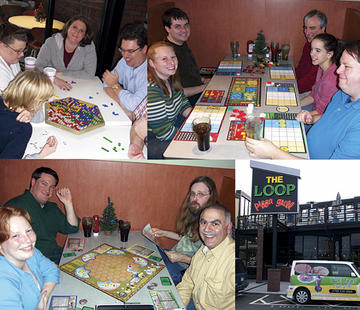
Atlanta has an active gaming scene and supports a number of gaming groups. Getting together with friends to play games has been a particular pleasure of mine for many years. In addition to my weekly group that has been playing for over twenty years, I host thirty public gaming events in Atlanta each year. My wife recently counted them all up.
 Of course there's no reason to re-invent the wheel, so you should check to see if there is already clubs, groups or stores that have organized play in your area. There are a number of sources on the internet and many game companies have information on locations of organized play at their sites. Try entering the name of your favorite game and your city's name into Google and see what it yields. I maintain a list of public boardgame groups at Boardgamenews.com.
But let's say, for whatever reason, you want to organize your own group. The first thing to decide is do you want it to be a public or private group. Each has their advantages and disadvantages. You can always do both, I do. Private groups can be easier to organize, since you only need two or three others who agree to meet on a regular basis. My group meets every Thursday from 8-11 PM and we rotate who hosts. If the same person or persons are hosting most of the time, maybe the others can bring snacks. The way it works with my Saturday group, I provide sodas and the guests bring the snacks. The main thing is to set a schedule and try to stick to it. Agreeing to decide later when to meet usually won't work out as well.
The same is true for a public group. The most important thing is to schedule regular sessions and show up for them. For boardgames, you only need three to play, fewer for most CCGs and only a few more for RPGs. So you and two friends can be the foundation for a very successful group.
I love getting together with friends for my regular sessions, but the public events are very satisfying as well. I enjoy meeting new folks and hosting these events has greatly increased my social circle. We meet the second Wednesday and last Saturday of every month. We get slightly different crowds for each one. It started with maybe eight folks and we now get between sixteen and thirty at each event.
The two things you need to make a public group successful are a good place to meet and ways to publicize the group. Game stores are a good place to consider. Many already run gaming. Some also have "open" gaming. Even if you decide not to play at a store, that may be an excellent place to find players (assuming you aren't playing at another store, of course). I don't recommend having "open" events in your home. You want to be able to freely promote the event online and in flyers around town and you can't do that safely if it is your home address. Have your friends to the house, do your public gaming in public.
My group plays at a local pizza restaurant and that has worked out very well. The trick is to find a place that is interested in having you there. The local area has a lot of office parks, so there are a number of places that do more business at lunch than dinner. They need to have the space for the lunch crowd but tend to be much less crowded in the evenings. Having 15-20 of us come in for four hours and play games hasn't been a problem, and most folks buy food and drinks while they are there, so it works out well for them as well. Tell your group to be cool and not bring in outside food or drink. Assuming you patronize the place, they should be happy to have you there. A restaurant may not be best for RPGs, but it works fine for boardgames and should be fine for CCG players as well. You want to be aware you are in public and not be loud or profane. Playing in public has also allowed us to expose others to the hobby. Other possibilities for meeting space can be libraries (if they have a separate room); churches, community centers and local social organizations can also be worth exploring.
Public game events are a chance to play, of course, but they are also social events. A games group is like a puppy, train them right early and you'll get years of enjoyment. Two small things can make a big difference in the experience. First, at the beginning of the game, introduce yourself to everyone and get his or her names. I'm terrible with names and am as likely to forget them as not, but the act itself puts the game into a more social situation. The other thing is when you are finished playing, stand up and check to see where the other players are at in their games. If something is finishing up around the same time, wait so the folks in both groups can reconfigure for another game. Getting folks to mix can be difficult, especially if folks show up together, they tend to want to stay together, but if you can get everyone into the spirit of changing partners, it really works out well. You get to see more of the group each time and if there are folks who aren't a favorite to play with, it gives you a chance to play a minimum number of games with them.
Introductions and mixing, especially if you can get everyone in the habit of doing it, will go a long way to creating a fun and social atmosphere. It is also helpful in creating a situation where the group will be more self-sustaining. Because of travel I had to miss both the October sessions, but they still happened and went fine without me. It's more fun when you feel that, even as the organizer, you don't have to be there.
In terms of publicizing your new group, local shops (if you are playing in a restaurant and nobody is selling games to the group) should probably be willing to hand out flyers about the group. Online, meetup.com is a good resource. They may already have a group in your area, if not it is easy to start one and we get one or two new folks each session. But it costs money to run a group there, which will diminish the appeal for many, I'm sure. Starting a Yahoo group is a good idea so members can communicate in between sessions and you can contact everyone.
Good places to announce the group include Yahoo and the newsgroups. A search for key phrases such as the name of a popular game will yield a list of groups that might be good candidates for announcements. For other resources online, Erik Anderson has a couple of good articles on starting a game group at Boardgames.about.com.
I encourage everyone with an interest to find a group or consider starting one if you feel the need. As a result of my Atlanta group, friendships have been formed and even romances. Who knows, someday there may be a new gamer in the world because of the gaming group. That's a pretty good deal for two days a month!
Author's note: This column originally appeared in Scrye magazine #94.
Ward Batty is a long-time game-player who has been with the same weekly game group for over twenty years. "I understood there was a pension." is his excuse. He writes a monthly column on the business of board games for Comics & Game Retailer magazine and has written articles and reviews for The Games Journal, Scrye, Knucklebones and Games International.
The Game Table is a weekly column which is self-syndicated by the author. If you would like to see this column in your local newspaper, please write the managing editor of the paper. Interested in carrying The Game Table in your paper, please contact Ward Batty
Atlanta has an active gaming scene and supports a number of gaming groups. Getting together with friends to play games has been a particular pleasure of mine for many years. In addition to my weekly group that has been playing for over twenty years, I host thirty public gaming events in Atlanta each year. My wife recently counted them all up.
 Of course there's no reason to re-invent the wheel, so you should check to see if there is already clubs, groups or stores that have organized play in your area. There are a number of sources on the internet and many game companies have information on locations of organized play at their sites. Try entering the name of your favorite game and your city's name into Google and see what it yields. I maintain a list of public boardgame groups at Boardgamenews.com.
But let's say, for whatever reason, you want to organize your own group. The first thing to decide is do you want it to be a public or private group. Each has their advantages and disadvantages. You can always do both, I do. Private groups can be easier to organize, since you only need two or three others who agree to meet on a regular basis. My group meets every Thursday from 8-11 PM and we rotate who hosts. If the same person or persons are hosting most of the time, maybe the others can bring snacks. The way it works with my Saturday group, I provide sodas and the guests bring the snacks. The main thing is to set a schedule and try to stick to it. Agreeing to decide later when to meet usually won't work out as well.
The same is true for a public group. The most important thing is to schedule regular sessions and show up for them. For boardgames, you only need three to play, fewer for most CCGs and only a few more for RPGs. So you and two friends can be the foundation for a very successful group.
I love getting together with friends for my regular sessions, but the public events are very satisfying as well. I enjoy meeting new folks and hosting these events has greatly increased my social circle. We meet the second Wednesday and last Saturday of every month. We get slightly different crowds for each one. It started with maybe eight folks and we now get between sixteen and thirty at each event.
The two things you need to make a public group successful are a good place to meet and ways to publicize the group. Game stores are a good place to consider. Many already run gaming. Some also have "open" gaming. Even if you decide not to play at a store, that may be an excellent place to find players (assuming you aren't playing at another store, of course). I don't recommend having "open" events in your home. You want to be able to freely promote the event online and in flyers around town and you can't do that safely if it is your home address. Have your friends to the house, do your public gaming in public.
My group plays at a local pizza restaurant and that has worked out very well. The trick is to find a place that is interested in having you there. The local area has a lot of office parks, so there are a number of places that do more business at lunch than dinner. They need to have the space for the lunch crowd but tend to be much less crowded in the evenings. Having 15-20 of us come in for four hours and play games hasn't been a problem, and most folks buy food and drinks while they are there, so it works out well for them as well. Tell your group to be cool and not bring in outside food or drink. Assuming you patronize the place, they should be happy to have you there. A restaurant may not be best for RPGs, but it works fine for boardgames and should be fine for CCG players as well. You want to be aware you are in public and not be loud or profane. Playing in public has also allowed us to expose others to the hobby. Other possibilities for meeting space can be libraries (if they have a separate room); churches, community centers and local social organizations can also be worth exploring.
Public game events are a chance to play, of course, but they are also social events. A games group is like a puppy, train them right early and you'll get years of enjoyment. Two small things can make a big difference in the experience. First, at the beginning of the game, introduce yourself to everyone and get his or her names. I'm terrible with names and am as likely to forget them as not, but the act itself puts the game into a more social situation. The other thing is when you are finished playing, stand up and check to see where the other players are at in their games. If something is finishing up around the same time, wait so the folks in both groups can reconfigure for another game. Getting folks to mix can be difficult, especially if folks show up together, they tend to want to stay together, but if you can get everyone into the spirit of changing partners, it really works out well. You get to see more of the group each time and if there are folks who aren't a favorite to play with, it gives you a chance to play a minimum number of games with them.
Introductions and mixing, especially if you can get everyone in the habit of doing it, will go a long way to creating a fun and social atmosphere. It is also helpful in creating a situation where the group will be more self-sustaining. Because of travel I had to miss both the October sessions, but they still happened and went fine without me. It's more fun when you feel that, even as the organizer, you don't have to be there.
In terms of publicizing your new group, local shops (if you are playing in a restaurant and nobody is selling games to the group) should probably be willing to hand out flyers about the group. Online, meetup.com is a good resource. They may already have a group in your area, if not it is easy to start one and we get one or two new folks each session. But it costs money to run a group there, which will diminish the appeal for many, I'm sure. Starting a Yahoo group is a good idea so members can communicate in between sessions and you can contact everyone.
Good places to announce the group include Yahoo and the newsgroups. A search for key phrases such as the name of a popular game will yield a list of groups that might be good candidates for announcements. For other resources online, Erik Anderson has a couple of good articles on starting a game group at Boardgames.about.com.
I encourage everyone with an interest to find a group or consider starting one if you feel the need. As a result of my Atlanta group, friendships have been formed and even romances. Who knows, someday there may be a new gamer in the world because of the gaming group. That's a pretty good deal for two days a month!
Author's note: This column originally appeared in Scrye magazine #94.
Ward Batty is a long-time game-player who has been with the same weekly game group for over twenty years. "I understood there was a pension." is his excuse. He writes a monthly column on the business of board games for Comics & Game Retailer magazine and has written articles and reviews for The Games Journal, Scrye, Knucklebones and Games International.
The Game Table is a weekly column which is self-syndicated by the author. If you would like to see this column in your local newspaper, please write the managing editor of the paper. Interested in carrying The Game Table in your paper, please contact Ward Batty
Wednesday, May 03, 2006
The Unsinkable Puerto Rico
By Ward Batty
This week I want to talk about what is arguably the best boardgame of all time, Puerto Rico by Andreas Seyfarth. It has recently regained the top spot as the top-rated game at Boardgamegeek.com, after being temporarily overtaken by the upstart game Caylus. Puerto Rico has been a favorite for many serious boardgame aficionados since Alea and Rio Grande Games first published it in 2002.
Each player is developing their own version of San Juan on their own small board. The city area has space for the buildings, and there is a field area where crop tiles are placed. Players are competing to produce goods, which can be shipped for victory points or sold at market for money, known here as doubloons. Doubloons are used to buy buildings. The buildings are worth victory points, and also have special uses that help the player. There are buildings that allow players to get more money when they sell goods, for example.
The core of the game is the different roles that each player selects. These include building, producing goods, shipping goods, trading goods at the market, adding a new crop to your field, adding new colonists or just taking money. The first player gets to be the Governor, and at the end of the round the Governor passes to the next player. Everyone selects a different role, then the Governor is passed and all roles are returned to the center of the table and are available to be selected. The roles that were not selected have a doubloon each placed on them, to make them more desirable next time. When a player selects a role, they do the action first, and then all players in clockwise order also may take that action, if they can. The player who selected the action also gets an additional benefit. For example, the person who chooses to build gets a discount of one ducat off the cost of the building.
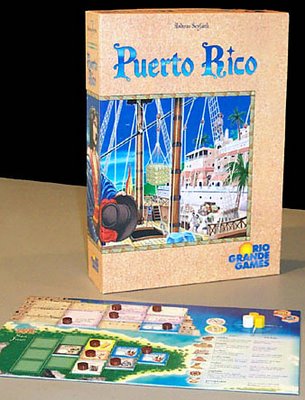 Designer Andreas Seyfarth didn't invent the game mechanic of players having roles that give them special abilities or privileges, but Puerto Rico uses it to great effectiveness. What distinguishes Puerto Rico from other games is the game flow. Timing is the only variable in the game. Everyone may build or ship, but not everyone can. You have to produce a good before you can ship or trade it. If someone with goods ships or trades before you have the chance to produce, not only do you miss on that chance to ship, but also shipping is unavailable until the Governor passes. In Puerto Rico, timing is everything.
Other than the number of victory points players have collected when they shipped goods, all information is public. So as you choose what role to take, you can easily see whom it will help and who still has a turn and what roles are available. This allows players to learn to anticipate what others will want to do. How you respond, take that action that most helps you but may help another more, or take a less appealing action so you won't set up the next player? This is the crux of the challenge and fun of the game.
As Peggy Hill says, "It's fun to choose." You get to make many interesting choices in Puerto Rico. There are only three boats that take goods away and they are three sizes and each may only contain one type of good. Also, they don't empty until filled. Goods are limited, so if too many goods remain on a boat they may not be available for future production. The trading house, where goods are sold, only has space for four goods and won't buy a second of the same good until the four spots are cleared. There is a building that let's players sell the same good again, however. Building selection is also very important. Some buildings are more useful early, some late. Many work well in combination.
Finally, Puerto Rico has lots of different ways to win. You can ship a lot, concentrate on making a lot of money and buying a lot of buildings, or select a middle course. There are three different ways the game can end, so a player that is building a lot or shipping a lot can try to bring the game to the end before an opponent?s plan can come to full flower. Again, in Puerto Rico, timing is everything. The greatest plan in the world can be no good if the game ends a turn too soon.
The game is recommended for ages twelve and up and that's pretty accurate for most kids. The game is relatively easy to learn, the abilities and privileges of each role are on the card, as are the abilities of the buildings. There's a PC version available, and sites where the game can be played online. There's a plethora of information available about the game at Boardgamegeek.com.
Puerto Rico is published in North America by Rio Grande Games and is for 3-5 players. Games take 45 to 90 minutes, depending on the number of players. Puerto Rico should be available locally at a specialty game shop. Even if the shop doesn't have the game in stock, many are happy to special-order them. Your local store is a great place to learn more about these great games. Online, I'd suggest going to Google, click on Froogle and search for the game by name.
Ward Batty is a long-time game-player who has been with the same weekly game group for over twenty years. "I understood there was a pension." is his excuse. He writes a monthly column on the business of board games for Comics & Game Retailer magazine and has written articles and reviews for The Games Journal, Scrye, Knucklebones and Games International.
The Game Table is a weekly column which is self-syndicated by the author. If you would like to see this column in your local newspaper, please write the managing editor of the paper. Interested in carrying The Game Table in your paper, please contact Ward Batty.
This week I want to talk about what is arguably the best boardgame of all time, Puerto Rico by Andreas Seyfarth. It has recently regained the top spot as the top-rated game at Boardgamegeek.com, after being temporarily overtaken by the upstart game Caylus. Puerto Rico has been a favorite for many serious boardgame aficionados since Alea and Rio Grande Games first published it in 2002.
Each player is developing their own version of San Juan on their own small board. The city area has space for the buildings, and there is a field area where crop tiles are placed. Players are competing to produce goods, which can be shipped for victory points or sold at market for money, known here as doubloons. Doubloons are used to buy buildings. The buildings are worth victory points, and also have special uses that help the player. There are buildings that allow players to get more money when they sell goods, for example.
The core of the game is the different roles that each player selects. These include building, producing goods, shipping goods, trading goods at the market, adding a new crop to your field, adding new colonists or just taking money. The first player gets to be the Governor, and at the end of the round the Governor passes to the next player. Everyone selects a different role, then the Governor is passed and all roles are returned to the center of the table and are available to be selected. The roles that were not selected have a doubloon each placed on them, to make them more desirable next time. When a player selects a role, they do the action first, and then all players in clockwise order also may take that action, if they can. The player who selected the action also gets an additional benefit. For example, the person who chooses to build gets a discount of one ducat off the cost of the building.
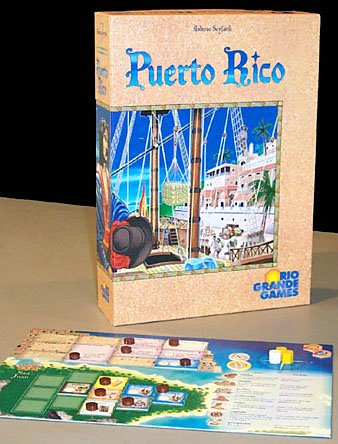 Designer Andreas Seyfarth didn't invent the game mechanic of players having roles that give them special abilities or privileges, but Puerto Rico uses it to great effectiveness. What distinguishes Puerto Rico from other games is the game flow. Timing is the only variable in the game. Everyone may build or ship, but not everyone can. You have to produce a good before you can ship or trade it. If someone with goods ships or trades before you have the chance to produce, not only do you miss on that chance to ship, but also shipping is unavailable until the Governor passes. In Puerto Rico, timing is everything.
Other than the number of victory points players have collected when they shipped goods, all information is public. So as you choose what role to take, you can easily see whom it will help and who still has a turn and what roles are available. This allows players to learn to anticipate what others will want to do. How you respond, take that action that most helps you but may help another more, or take a less appealing action so you won't set up the next player? This is the crux of the challenge and fun of the game.
As Peggy Hill says, "It's fun to choose." You get to make many interesting choices in Puerto Rico. There are only three boats that take goods away and they are three sizes and each may only contain one type of good. Also, they don't empty until filled. Goods are limited, so if too many goods remain on a boat they may not be available for future production. The trading house, where goods are sold, only has space for four goods and won't buy a second of the same good until the four spots are cleared. There is a building that let's players sell the same good again, however. Building selection is also very important. Some buildings are more useful early, some late. Many work well in combination.
Finally, Puerto Rico has lots of different ways to win. You can ship a lot, concentrate on making a lot of money and buying a lot of buildings, or select a middle course. There are three different ways the game can end, so a player that is building a lot or shipping a lot can try to bring the game to the end before an opponent?s plan can come to full flower. Again, in Puerto Rico, timing is everything. The greatest plan in the world can be no good if the game ends a turn too soon.
The game is recommended for ages twelve and up and that's pretty accurate for most kids. The game is relatively easy to learn, the abilities and privileges of each role are on the card, as are the abilities of the buildings. There's a PC version available, and sites where the game can be played online. There's a plethora of information available about the game at Boardgamegeek.com.
Puerto Rico is published in North America by Rio Grande Games and is for 3-5 players. Games take 45 to 90 minutes, depending on the number of players. Puerto Rico should be available locally at a specialty game shop. Even if the shop doesn't have the game in stock, many are happy to special-order them. Your local store is a great place to learn more about these great games. Online, I'd suggest going to Google, click on Froogle and search for the game by name.
Ward Batty is a long-time game-player who has been with the same weekly game group for over twenty years. "I understood there was a pension." is his excuse. He writes a monthly column on the business of board games for Comics & Game Retailer magazine and has written articles and reviews for The Games Journal, Scrye, Knucklebones and Games International.
The Game Table is a weekly column which is self-syndicated by the author. If you would like to see this column in your local newspaper, please write the managing editor of the paper. Interested in carrying The Game Table in your paper, please contact Ward Batty.
Wednesday, April 26, 2006
Time to Teach You About Tichu
By Ward Batty
This week we are going to focus on a popular four-player partnership card game called Tichu, which is pronounced like "teach-you," see how funny my headline is now? When I had a store we had an employee who said that Tichu was adapted from an old Chinese game played with a regular deck of cards called Zheng Fen. Of course, he said the same thing about Monopoly, so who knows? What I can confirm is that Tichu was designed by Urs Hostettler and first published in Germany in 1991. Tichu is currently available in North America from Rio Grande Games.
 The Tichu deck consists of a standard 52-card deck and four special cards, Mah Jong, Dog, Phoenix and Dragon. After receiving their hand of fourteen cards, players select three cards they give to each of the other three players. Before playing their first card, each player has the right to declare a small "Tichu" If he then wins the round, his team receives an extra 100 points - otherwise the team loses 100 points. The object of Tichu is to be the first to play all your cards.
A player may lead a card, or any of the following combinations of cards: a pair, a run of pairs of adjoining values (8,8,9,9,10,10, for example), three cards of the same value, a full house (triple and pair), or a straight of at least five cards. The next player may either pass or play a similar combination but of a higher value. The only exception to this rule is playing the "Bomb," which is a straight flush or four of a kind. It is legal for players to pass and then come back in again as long as some other player played in between.
If all four players pass consecutively, the player who last played takes the trick and starts play again. Play continues until three of the four players have played all of their cards. The one player remaining, who still has cards in his hand, gives any remaining cards in his hand to the opposing team and all the tricks he has won to the winner of the round (the player who was the first to play all his cards). The hand is now scored. Fives, Tens and Kings are worth points, and each hand worth one hundred points (without bonuses). The first team to a thousand points wins. Full rules as well as a description of the four special cards can be found at the Game Cabinet.
To try to convey the great appeal of Tichu, I asked several players to help explain the zeal the game engenders. Derek Carver says "To knock Bridge would be crazy. Yet Bridge is one of the only games I know where simply learning the rules doesn't allow you to play the game. It is the conventions that have been superimposed upon the game that have made it what it is. This means it's no use visiting friends and saying 'Let's have a great evening at cards - I'll teach you Bridge!' Tichu on the other hand can certainly be taught in a normal gaming evening and it'll then simply depend upon your 'card sense' as to whether you play it well.
"What do I find so great about Tichu?" asks Michael Weston, "Tichu has several elements that each provides for a fun mental challenge in a trick taking game with almost the depth of Bridge, at least Bridge up to the moderate level of play. There's the real angst and tension of calling a Tichu. The decision of what to pass is not always cut-and-dried, especially the card to your partner. How to play any given hand can vary and shift. You could repeat the exact same deal several times and play quite differently each time."
Of his Tichu experience, Chris Lohroff says "As a person that is learning to play bridge my first comment would be that is a LOT more accessible than bridge. After more than a year of playing at lunch everyday, we still have to refer to our bridge bidding convention sheets. A person can learn the basics of Tichu and play reasonably well after just a few games."
Jonathan Degann says, "What I like about the game is that it lets you look at your hand and create alternative strategies around playing it and organizing it. Every hand is a story, and you have to direct it to its full potential to determine if it has a happy or sad ending."
 "It is neat how a given hand can be organized multiple ways. Do I play this really long straight, knowing that it will break up some low unmatched pairs - or do I break up the straight so that I can keep my pairs together? What can I do to get the lead and how will I be able to keep it? Do I have a viable plan for getting it back if I lose it prematurely? I suppose experienced Bridge players go through the same thing. I don't play Bridge and can't speak for them. But I am able to plot out the life of my hand in Tichu with more interest than with any one-card-at-a-time trick taking game that I play."
Richard Irving says "In learning Tichu, one should stopping calling it, and trying to play it as, a "trick-taking game" because it is not. This misapprehension that Tichu is a trick-taking game causes many new players to mistake the capturing of point cards (which is an important aspect of many actual trick-taking games) and forego getting out as quickly as possible (which is never part of any trick-taking game.) Many new players focus on not playing the Dragon or Phoenix when necessary --because it'll cost you 25 points or trying to capture that pair of 10's, etc. These are habits are ingrained from playing trick taking games."
I'll give Matthew Baldwin the last word. "I'm relatively new to Tichu (just started playing a few months ago), but hooked all the same. Perhaps my favorite aspect is that it feels like the best parts of a whole range of game genres packed into one package. There's the partnership element of bridge; there's the "try to go out first" element from Great Dalmuti; there's the "try to capture points" element of Spades; there's the "create combinations" element from poker and rummy; and while a player may have a grand strategy, he may need to make tactical decision based on how the hand plays out. There's also the gambling element: not just in the call of Tichu, but in the decision to break up a good combination to take a trick: Should I play an ace, claim this trick, and save my other ace for a future play, or should I hang onto it and keep the two aces as a pair?"
"The game is less huge helping of a single food and more a buffet."
Ward Batty enjoys a good buffet and is a long-time game-player who has been with the same weekly game group for over twenty years. "I understood there was a pension." is his excuse. He writes a monthly column on the business of board games for Comics & Game Retailer magazine and has written articles and reviews for The Games Journal, Scrye, Knucklebones and Games International.
The Game Table is a weekly column which is self-syndicated by the author. If you would like to see this column in your local newspaper, please write the managing editor of the paper. Interested in carrying The Game Table in your paper, please contact Ward Batty.
Wednesday, April 19, 2006
If I Were King of the Forest
By Ward Batty
Since I closed my game store in early 2005 and have been doing freelance writing, I've received some interesting job offers. One of the more interesting occurred recently. It was from a game company we'll call the Acme Game Co. A third party passed on the offer in the form of "How would you like to be Mr. Acme Game Co.?" I have a job co-publishing Comic Shop News, but thanks to the timesaving computer and internet it doesn't take as many days each week as it used to, which is why I've had time to do the writing and, prior to that, my store. But it was, as presented, such an intriguing idea that I had to at least entertain it.
I received the offer at Essen and it was a week before I finally was able to speak with Acme, so I made a bunch of notes of ideas, which I presented to them at first opportunity. This is probably not the best way to get hired, "Hi, thanks for considering me for the position, here's everything you are doing wrong." But I wanted them to know what they were getting if they hired me. Turns out, as they so tactfully put it, they were really in need of "someone to handle the daily nuts and bolts of the business rather than the strategic needs" which has less appeal to me, so I passed. I ended up with all these notes and nothing to do with them, so I decided to share them with you and at least I'll get a column out of the experience. Plus it is always nice to be asked.

Many of the notes dealt with specifics of how they are currently running things at Acme as well as properties that might be worth looking at, so I'll omit all that. For our purposes, I'll just include my more general ideas about how I would have run things. The advantage of these ideas is they won't be put to the cruel test of reality, so they will always be pure. That's why we have columnists, BTW.
I advised Acme to stop selling direct. This was always an issue with me as a retailer, the publisher as a competitor. They have what's called a three-tier system, (publisher/distributor/retailer) which I think works for a reason. Also, I don't think it is the best use of the publisher's time and efforts at conventions. This is a complex issue I can't address in detail in this space or forum, but that's what I would do of I had become Mr. Acme Games.
One advantage of not selling direct is it greatly simplifies what is needed to have a presence at more conventions, since if you aren't trying to be a retailer, you can use a mostly volunteer workforce at these events. Looney Labs has a volunteer force called "Bunnies" that is something to behold. Not a week went by when I had a store that I wasn't contacted by a Bunny about doing an in-store demo for one of their games. I'm not sure how they accomplish such a devoted group of volunteers, but it is an invaluable asset to them and I wanted to see how to replicate it.
Another idea worth stealing is the promotion Days of Wonder did with the Sir Bedivere figure for Shadows Over Camelot. When you have a game where it would be relatively cheap to create a bonus card, tile or piece that would be a great thing that can be distributed through retailers, conventions and magazines. They do this more with CCGs, and while obviously a gimmick, I think it adds a lot of value and enhances the customer's experience.
There was a great promotional video that one of the CCG companies did a couple of years back. It was an attractive girl doing a demo of this card game. It was maybe five minutes. You could download it as a movie file and I believe they also made it available on a DVD to shops. With digital technology these promotional films are much cheaper to do and edit and distribute than in the past, and I think that would be worth doing. This leads me to the next thing I wanted to explore, a rule-set that would be included on a DVD with every game. A combination of flash animation and digital shots of the game would be very doable at this point. People dread having to learn the game from the rules and, as we all know, having someone who can show and explain the rules is preferable than having to plum the rulebook.
The educational supply and toy stores are a much bigger market in the US than the game stores. Parents will also spend more for an item they believe is educational or mentally stimulating. There are hurdles in terms of distribution, but that market is always worth pursuing.
I've had a dream of selling small box and card games from vending machines at airports. You can buy an ipod from a vending machine, why not a game?
I don't believe that the Rio Grande Games model of gang printing in Germany to create an English version of the game will work at this point for anyone other than RGG and Mayfair. Acme probably isn't getting first or even second dibs on new games published in Germany, so they are stuck releasing lesser titles, which is no way to establish a reputation. With the dollar still weak against the euro you end up with very pricey games, which are harder to sell. Most US publishers have responded by trying to get the rights to produce the English-language version, which is then generally produced in China so it can be list priced at $35 and not $50. $40 is sort of a magic number for boardgames in this market. If you have something that costs more than $40, there needs to be something spectacular about it. There are a lot of games in the marketplace and I think that the Days of Wonder approach of releasing fewer games and making sure each is really good makes more sense than a more scattershot approach of releasing a game a month or more. If you can make the numbers work, I'd say between 2 and 4 releases a year would be ideal. Gives you a chance to focus your marketing.
Which brings me to the next thing I'd do if I was Mr. Acme Games Co. and that's get some mainstream press coverage! I maintain a site that links to mainstream media stories about board games. Maybe 5% of these stories are about "our" kind of games. I don't understand why publishers get so little free press but I am certain I could change that. In the two years I had my store, we had around a half-dozen stories on local (and in one case national) media and we are just a store. I am certain I could get Acme much more press than anyone currently receives. Very few game publishers send out press releases, so it won't be that hard to do better. I'd also develop better relationships with what we'll call the fan press.
I have a theory that comics and science fiction people (the other two fandoms I'm familiar with) tend to include the liberal arts majors while gamers tend to be more the engineering and math types. The results of this can be seen in how we write about our hobby. With comics and SF you get reviews, of course, but also a lot of writing about the hobby and a strong emphasis on the history of the hobby and the creators involved. You get things like faan fiction. Our closest version of that might be variants, open game systems and the fact that every gamer is also a closet designer. But most writing about games is reviews that include detailed descriptions of the game mechanics. Almost like something you'd find in a user's manual or scientific review. Of course, I'm making generalizations here and, of course, all generalizations are wrong. I'm digressing, but the net effect is that game publishers send out press releases much less than comics publishers. Comics also get a ton more mass-media coverage than boardgames and the level of the mass media's understanding of the medium is much more sophisticated than it is for board games. But educating the public is a process and it takes time.
I would have Acme sponsor a design competition modeled after the Hippodice. I suspect the officiating is a bit of a nightmare. Since it is such a close-knit community, maybe make the designer identity a secret during the competition and only announce the winners' names. Acme could promise to publish the winning design as the big prize.
That's it. Obviously, I'm not re-inventing the wheel here. Most of these ideas aren't original, but hardly anybody is following this particular course either. It would have been interesting being Mr. Acme Games, but I would've had to give up all my writing, and I already have another project I'm pursuing. I may never be Mr. Acme Games, but I'll always be Mr. Entrepreneur.
Ward Batty is a long-time game-player who has been with the same weekly game group for over twenty years. "I understood there was a pension." is his excuse. He writes a monthly column on the business of board games for Comics & Game Retailer magazine and has written articles and reviews for The Games Journal, Scrye, Knucklebones and Games International.
The Game Table is a weekly column which is self-syndicated by the author. If you would like to see this column in your local newspaper, please write the managing editor of the paper. Interested in carrying The Game Table in your paper, please contact Ward Batty.
Since I closed my game store in early 2005 and have been doing freelance writing, I've received some interesting job offers. One of the more interesting occurred recently. It was from a game company we'll call the Acme Game Co. A third party passed on the offer in the form of "How would you like to be Mr. Acme Game Co.?" I have a job co-publishing Comic Shop News, but thanks to the timesaving computer and internet it doesn't take as many days each week as it used to, which is why I've had time to do the writing and, prior to that, my store. But it was, as presented, such an intriguing idea that I had to at least entertain it.
I received the offer at Essen and it was a week before I finally was able to speak with Acme, so I made a bunch of notes of ideas, which I presented to them at first opportunity. This is probably not the best way to get hired, "Hi, thanks for considering me for the position, here's everything you are doing wrong." But I wanted them to know what they were getting if they hired me. Turns out, as they so tactfully put it, they were really in need of "someone to handle the daily nuts and bolts of the business rather than the strategic needs" which has less appeal to me, so I passed. I ended up with all these notes and nothing to do with them, so I decided to share them with you and at least I'll get a column out of the experience. Plus it is always nice to be asked.

Many of the notes dealt with specifics of how they are currently running things at Acme as well as properties that might be worth looking at, so I'll omit all that. For our purposes, I'll just include my more general ideas about how I would have run things. The advantage of these ideas is they won't be put to the cruel test of reality, so they will always be pure. That's why we have columnists, BTW.
I advised Acme to stop selling direct. This was always an issue with me as a retailer, the publisher as a competitor. They have what's called a three-tier system, (publisher/distributor/retailer) which I think works for a reason. Also, I don't think it is the best use of the publisher's time and efforts at conventions. This is a complex issue I can't address in detail in this space or forum, but that's what I would do of I had become Mr. Acme Games.
One advantage of not selling direct is it greatly simplifies what is needed to have a presence at more conventions, since if you aren't trying to be a retailer, you can use a mostly volunteer workforce at these events. Looney Labs has a volunteer force called "Bunnies" that is something to behold. Not a week went by when I had a store that I wasn't contacted by a Bunny about doing an in-store demo for one of their games. I'm not sure how they accomplish such a devoted group of volunteers, but it is an invaluable asset to them and I wanted to see how to replicate it.
Another idea worth stealing is the promotion Days of Wonder did with the Sir Bedivere figure for Shadows Over Camelot. When you have a game where it would be relatively cheap to create a bonus card, tile or piece that would be a great thing that can be distributed through retailers, conventions and magazines. They do this more with CCGs, and while obviously a gimmick, I think it adds a lot of value and enhances the customer's experience.
There was a great promotional video that one of the CCG companies did a couple of years back. It was an attractive girl doing a demo of this card game. It was maybe five minutes. You could download it as a movie file and I believe they also made it available on a DVD to shops. With digital technology these promotional films are much cheaper to do and edit and distribute than in the past, and I think that would be worth doing. This leads me to the next thing I wanted to explore, a rule-set that would be included on a DVD with every game. A combination of flash animation and digital shots of the game would be very doable at this point. People dread having to learn the game from the rules and, as we all know, having someone who can show and explain the rules is preferable than having to plum the rulebook.
The educational supply and toy stores are a much bigger market in the US than the game stores. Parents will also spend more for an item they believe is educational or mentally stimulating. There are hurdles in terms of distribution, but that market is always worth pursuing.
I've had a dream of selling small box and card games from vending machines at airports. You can buy an ipod from a vending machine, why not a game?
I don't believe that the Rio Grande Games model of gang printing in Germany to create an English version of the game will work at this point for anyone other than RGG and Mayfair. Acme probably isn't getting first or even second dibs on new games published in Germany, so they are stuck releasing lesser titles, which is no way to establish a reputation. With the dollar still weak against the euro you end up with very pricey games, which are harder to sell. Most US publishers have responded by trying to get the rights to produce the English-language version, which is then generally produced in China so it can be list priced at $35 and not $50. $40 is sort of a magic number for boardgames in this market. If you have something that costs more than $40, there needs to be something spectacular about it. There are a lot of games in the marketplace and I think that the Days of Wonder approach of releasing fewer games and making sure each is really good makes more sense than a more scattershot approach of releasing a game a month or more. If you can make the numbers work, I'd say between 2 and 4 releases a year would be ideal. Gives you a chance to focus your marketing.
Which brings me to the next thing I'd do if I was Mr. Acme Games Co. and that's get some mainstream press coverage! I maintain a site that links to mainstream media stories about board games. Maybe 5% of these stories are about "our" kind of games. I don't understand why publishers get so little free press but I am certain I could change that. In the two years I had my store, we had around a half-dozen stories on local (and in one case national) media and we are just a store. I am certain I could get Acme much more press than anyone currently receives. Very few game publishers send out press releases, so it won't be that hard to do better. I'd also develop better relationships with what we'll call the fan press.
I have a theory that comics and science fiction people (the other two fandoms I'm familiar with) tend to include the liberal arts majors while gamers tend to be more the engineering and math types. The results of this can be seen in how we write about our hobby. With comics and SF you get reviews, of course, but also a lot of writing about the hobby and a strong emphasis on the history of the hobby and the creators involved. You get things like faan fiction. Our closest version of that might be variants, open game systems and the fact that every gamer is also a closet designer. But most writing about games is reviews that include detailed descriptions of the game mechanics. Almost like something you'd find in a user's manual or scientific review. Of course, I'm making generalizations here and, of course, all generalizations are wrong. I'm digressing, but the net effect is that game publishers send out press releases much less than comics publishers. Comics also get a ton more mass-media coverage than boardgames and the level of the mass media's understanding of the medium is much more sophisticated than it is for board games. But educating the public is a process and it takes time.
I would have Acme sponsor a design competition modeled after the Hippodice. I suspect the officiating is a bit of a nightmare. Since it is such a close-knit community, maybe make the designer identity a secret during the competition and only announce the winners' names. Acme could promise to publish the winning design as the big prize.
That's it. Obviously, I'm not re-inventing the wheel here. Most of these ideas aren't original, but hardly anybody is following this particular course either. It would have been interesting being Mr. Acme Games, but I would've had to give up all my writing, and I already have another project I'm pursuing. I may never be Mr. Acme Games, but I'll always be Mr. Entrepreneur.
Ward Batty is a long-time game-player who has been with the same weekly game group for over twenty years. "I understood there was a pension." is his excuse. He writes a monthly column on the business of board games for Comics & Game Retailer magazine and has written articles and reviews for The Games Journal, Scrye, Knucklebones and Games International.
The Game Table is a weekly column which is self-syndicated by the author. If you would like to see this column in your local newspaper, please write the managing editor of the paper. Interested in carrying The Game Table in your paper, please contact Ward Batty.
Wednesday, April 12, 2006
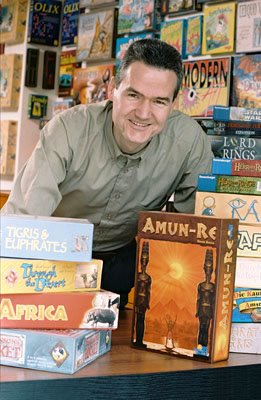
Reiner Knizia by the Numbers
 By Ward Batty
Reiner Knizia is probably the most prolific game designer of all time, with over 200 published games. The number of Knizia games that have been or are scheduled to be published this year alone is over forty. While some of these are re-releases of older, previously published games, for one designer to produce so many titles is quite a feat. Consider that most boardgame companies don't release forty games a year.
You don't achieve this sort of creative production without taking a systematic approach. Knizia rises at 4:30 each morning, a habit from his days when we was designing games in addition to working in banking. His early morning hours, during which he says he is his most creative, are spent exercising and thinking about his designs. His afternoons are spent in his office, dealing with publishers and other tasks, such as speaking with the press. Evenings are spent in play testing sessions with the number of groups around London, where he currently resides.
Knizia says that game design has been an interest of his since early childhood. "I have some games in the basement that I designed when I was six years old. Even so, in my early years, I never tried to publish any of these games. The excitement was in playing them. It seemed that I could never find, or be able to afford, enough new games in the shops and I didn't see the themes that interested me, so I would invent my own to play. I would also make a lot of games around Monopoly. We would play it sometimes, but I would also take the money from the game and improvise a new game around that. With many games, I would play it a few times, get an overview, and start experimenting with my own rules."
Unlike many designers who work on games with other designers, Knizia works alone. While he is the sole designer, Knizia works in conjunction with his many play test groups. By working with several groups of play testers he can draw on their collective experience. "I'm very sure it wouldn't work for me to collaborate with one specific other designer. When I'm very excited about a game I can become very obsessed about it and will spend a lot of time on it. With my play testers I get a lot of input from them and I owe them a lot. We have been together now for many years and they bring a lot of variety into the process."
Knowing Knizia's past as a mathematician and having played many of his games that feature number cards, often with one through six, I had concocted a theory of how Knizia was sharing his inherent love of numbers with the world through his games. Reality differs from my theory in this case as he tells me that most of his game designs begin with the theme. "The theme, mechanics and the materials in the game must work as one unit and if they don't gel together I think the game is not complete. Sometimes people say that my games are a bit abstract. I'm a more scientific man. My approach is that the game should have very simple rules and depth of play comes out of these simple and unified rules. There may be a lot of details, but usually I have a good thematic reason for these additions."
 Does Reiner Knizia have an inherent love for the numbers 1-6? "I think that every designer has his own handwriting,? admits Knizia, "Maybe you discover things about me from playing my games that I don't know about myself. But I am a scientist and that influences my character and how I see the world. So maybe my games have more of the analytical side stressed, not because I am doing this in awareness but more because that's who I am and that's how my world looks like. But there is a second aspect to it. I believe that games and especially the rules should be simple. I don't, for example, think it is necessary to operate with big numbers. Why should players have to add up 47 plus 39? I'm trying to reduce the game points and many aspects of the game to very simple numbers and mechanics. If players fight over 4 or 5 points it is the same as if they fight over 400 or 500 points. Therefore I am reducing many of my systems to small numbers. The numbers 1-6 does not obsess me; it is just that when you reduce it to small numbers you will always end up with the numbers 1-6. I don't want to distract people with big numbers or the handling of the game components. I want to make the world very easy to the players so they can then concentrate on their game strategy."
Knizia's systematic approach also extends to the type of games he designs. These cover a wide range from Tigress & Euphrates, one of the most-respected "gamer's games" to children's games and even licensed tie-in. Knizia has designed games for such properties as the Lord of the Rings, Simpsons, Bibi Blocksberg, Star Wars, King Arthur and even Donald Duck. "When I decided to design games full-time eight years ago, I didn't want to dig deeper into the same type game all the time." Knizia says, "I wanted to spread out my interest. I want to work for different audiences, work with different game systems, and different themes even different possibilities like having electronics in the game. So I want to do children's games and two-player games and whatever else I can think of. Anything I haven't done yet is particularly exciting for me. I read Donald Duck comics as a child, so now to be doing a game with that character, I find that very thrilling. It took a while to be able to get access to these projects and now I enjoy having that access."
After creating mostly games for the adult and family market early in his career, over the last few years he has turned his interest to children's games. You can't just take a strategy game and make the strategy easier, Knizia says, "I think that would be the wrong approach to fascinate children. Children see the world with different eyes. They touch much more than we adults do. They want to experience the game with their fingers and hands and even put things in their mouth. So the experience and the components play a much bigger role. This fires up their imagination. You can't put a black and white abstract thing in front of them and say this is so-and-so, they just don't see that. So I think one needs to come from a more optical and tactile experience. The world of the game needs to be the kids' world, simple and lovely. The rules need to be very short and simple. You need to speak to the kids through their language, to their perception of the world."
Children's games have to be play tested with kids and this has its particular challenges, says Knizia. "One good thing is that the kids are not nice to you, they are simply honest. They don't even say anything, necessarily. You can tell by watching if they are fascinated with the game. Either they are concentrating on the game or they run off and do something else. You get very good feedback and very good insights. Since I've been playing with children, especially small children, I've learned a lot about the essence of playing. Of course they also have a great ability to destroy everything. My prototypes usually don't last very long when I'm playing them with kids (laughs). But that's part of the play testing as well because then we know what materials we can and can not use."
One can't get over 200 games published without an understanding of the commercial side of the business. Knizia explains there are two very different categories of game design. "One is the pre-game design where I come up with my own ideas and I'm not thinking of the finished product. The other is an up-front agreement to do a specific type of game and then I have to deliver that. The first kind is much more fun. I sit down and develop my own ideas and then I don't really have a target group in mind. I always say the game is like a child. You can lead and you can guide it, but eventually it develops by itself and it will have its own personality." During the development process, a game might start as a card or a board game and then would develop into a tile-laying game and then the theme would change. Many games that are published end up being very different from the genesis of the idea. "Why should I restrict myself by saying this has to be a certain way? It is best to let the game naturally develop into something that can create the most fun and excitement."
The other type is when there is an up-front agreement. "In these situations," explains Knizia; "I need a publisher and the agreement up front so we can acquire the license. Then there is also the understanding of what the target market is, how expensive the game will be, at what point in time will it come out and what sort of materials we can use. So there are many restrictions coming in and of course you also have a deadline. So it is less fun, more work and much more demanding. It's a much bigger challenge to do, but, of course, these are usually the big, very exciting projects which are certainly worth doing as well."
Knizia has been successful getting games published in both the US and Europe, but acknowledges that the markets are different. Says Knizia, "In America, the theme is seen as the game where as in the European the game mechanics and the game system are seen as the game." Knizia tells a story about when he took a game prototype to America. It had an Egyptian theme and when an American publisher saw the theme they said, "We are not interested in this game, we have a game about Egypt and we don't need another." So Egypt was the game to them. Knizia asked them "Won't you at least have a look at it?" and they said no, we don't want this game. A few weeks later he was back in Germany showed the same game to a German publisher. The publisher sees the game has an Egyptian theme and says "Oh, are just in preparation of an Egyptian-themed game, so the Egyptian theme wouldn't work for us. But let's see the game first and then we can see what we'll do about the theme." In Germany the game was not the theme, but the game system. So there is a very different perception of what is a "game." For Knizia, that understanding is the starting point for what games he offers to the different markets.
But even in the same market, publishers are very different. They have their own niches and look for their own products, but they also vary in how they produce the games and the criteria by which they choose what to publish. Once accepted, some will take the game as delivered and some want to add their own ideas. "Sometimes these ideas are good, and sometimes they are not so good." says Knizia, "Some publishers are much more pleasant to work with than other publishers. So you have a selection process where publishers are trying to choose the good games and I am trying to choose the good publishers."
Some Knizia games have more lives than Shirley McClain's cat. Quandary, Thor, Flinke Pinke and Loco are all various incarnations of the same basic game. Colossal Arena is a card game where creatures battle to the death and was previously published as Titan: The Arena. In one of the stranger re-theming of a game, it was originally published in Germany as Grand National Derby, based around the famous horse race in England. Knizia explains, "The mechanics were relatively simple and it worked very nicely. It is a steeplechase and a lot of horses do not finish and drop out during the different hurdles. Then when the idea came from the American publisher to do a Titan: the Arena game we needed to beef it up a little bit. So more thematic elements came in and that brought a bigger range of different abilities for the cards, which the original horses didn't have. So we have a game that was very much liked in both markets with very different themes. Another example is my game Through the Desert, which is now a game of moving caravans. The working title of my original design was Rockefeller. The original idea was an island filled with rich people each trying to out-do each other by building the biggest palace and the biggest golf course and linked to the nicest areas of the island. These became oasis and palm trees and caravans of camels. This theme was actually suggested by the publisher because they thought they could position it better. They were right as the game has done well in many different languages."
When a game is re-published Knizia admits he is rarely picking up the game again in such an intense way. It usually works one of two ways. He leaves the game as is, perhaps making changes in the wording of the rules, but not the rules themselves. In other cases, he uses the opportunity to significantly change the game, so it is almost a new game. Knizia says, "Sometimes a different market requires something else like we did with Shotten Totten which became Battle Line that had extra cards that were not in the basic game. The extra cards make it thematically richer, which I think is the right thing for the American market."
Knizia thinks that electronics will become part of the future of boardgames. He points out that electronics are everywhere, in all sorts of products we use and we aren't aware of them because we don't have to think about them. In games there has been a separation between the social boardgames and electronic games. The electronic games are played in front of a screen while boardgames are more social and you played around a table with other people. With new technology, this is changing and he thinks the challenge now is to integrate the electronics into the game in a way that the player doesn't have to learn to operate these electronics, it simply happens. Knizia designed one of the most innovative electronic games to date with the King Arthur game, published in Germany by Ravensburger in 2003. Knizia says the real innovation of the game is not in the electronics, but in the board, which was produced with conductive ink. "That's where the magic starts. Players sit around the table and play it as usual, moving their figures around the board, but each figure has a chip and when the figure is placed on a space, through the conductive ink, the chip communicates with the unit without the player doing anything. So the unit knows who that player is and where they are and what they are doing. That enables the electronics to react so that players meet different characters and face different challenges. It brings up a totally new and enriched game atmosphere. The electronics really support and drives along the game without the player having to do anything. That's how electronics will be accepted into social games, as a supporting and enriching factor, and we will see many more of these games in the future." Unfortunately for game fans stateside, the game speaks and there's no English version available at this point.
Sometimes a game that is very simple on the face of it has a certain "x-factor," a secret ingredient of fun that materializes. Games like Trendy, Exxtra and Honeybears are good examples of simple games by Knizia that have this quality. Is this something that can be consciously designed? "I think that is something that I strive for," says Knizia, "You can recognize it in play testing, but not something that you can plan for. Through intensive testing I want to get this sub-conscious element that grabs the people. They don't know why it grabs them and they don't need to know. I'm the designer. I need to put that in and they can just enjoy it. But there are certain elements of the game that click with people. That's the right mechanic. Another one works as well but this is the mechanic that grabs the people, that stimulates them and encourages them to open themselves. This comes through a lot of testing and good luck as well. But it is something to watch out for and to bring a game to the situation where people say 'I don't know what it is about it, but this is a game I like.' Of course this is a rare process. It is very difficult to get there, but with all the testing that's where I'm trying to drive my games."
As anyone who has tried their hand at game design knows, a simple and elegant game is often the most difficult to achieve. So which is easier for Knizia to design? "A complex game that plays very long and has a lot of aspects integrated into it needs a lot of testing and is quite a challenge to do. A smaller card game is in this respect simpler to do, so I think in this respect complexity requires more work. If I have a big game, I want to make this game really round, taking off the corners and so it is intuitive to play and, perhaps unconsciously, very addictive. I think making a well-rounded game is always difficult and that can be for a small card game or a children's game as well as a bigger game. How many rough corners are there in the individual categories? Fixing that's quite hard to do. Making an 80% game is very easy. A lot of games that are out there are just 80% finished. With more testing the game could be more elegant and the last 20% takes a lot of time. That's the difficult part."
Knizia has never self-published and has strong opinions on the subject. "Everyone has their strengths and weaknesses and I think that designing games and publishing games are two very different occupations." Knizia says. "I have a limited number of hours in the day and in my life and I want to do the things I can do best. If I started self-publishing, that means I would have to get into the production and then the selling and distributing of the games. It requires very different experience and it is a totally different business. I want to stay in the game design business and not go into the publishing business. If I say yes to something else then I have to say no to game designing, at least to a certain degree, and I don't want to do that. I think it's a very naive thing to say 'Now that I've designed a game I think I'll self-publish it.' I might as well become a book publisher or produce music CDs. That seems odd, but simply saying about a game 'that's the same product, so I can do that.' Well no, I can't, and I won't. The desperation of some people saying 'no one will publish my game so I'll do it' is, in my eyes, a very dangerous temptation.
A detailed discussion of Knizia's prolific output could fill a book, but I couldn't resist asking about a recent favorite of mine, and a game that is rather unusual for a Knizia design, Ingenious. About the game, Knizia says, "It is now out in 12 or 13 different languages and still growing in the market. It was agreed up front that we wanted to do a more abstract game and see if we can bring out the fascinations through the tactical and tactile fascination with the pieces and what is created with simple game play and an exciting scoring mechanism. I was very fascinated to do that because abstract games can be difficult to play and it is usually a risk to develop. It was relatively straightforward. I never ran into any real big problems. There was a lot of testing, of course. I think it turned out very well and a lot of people mention it to me. There will be a CD ROM version coming out soon that will have tweaks and extra challenges."
 Another favorite is Tigris & Euphrates, one of the most original and challenging games available. I was very intrigued to hear that a card game version was planned, and was quite impressed when I had the chance to try it at the game fair in Essen, Germany. About the game, Knizia says, "It is called the Euphrat & Tigris card game for a reason because the core elements of Euphrat & Tigris are in there as well. You don't have to know the board game, but what you have the four different colors, the king, the trader, the priest and the farmer and you have the leaders again so you are building kingdoms but with cards and no board. It isn't a two-dimensional way but more a one-dimensional way where the kingdoms are columns and you play the cards in the columns. I wanted to make it very simple so you don't have any scoring cubes. Whenever you make a red point or a green point you have to play these points as cards from your hand. So if you make a green point and don't have any more green cards you don't get any points. There's a different component to it. It is not only that you want to play the right cards into the kingdoms but you also want to keep the right cards to score your points with. So it's much simpler than the board game but the basic elements are there. You have the kingdoms, you have the leaders, and only one color of leader can be in a kingdom. You have internal conflicts, which are still done on the red colors, and you have external conflicts when you join together two columns of kingdoms and they are fought out with card colors of the conflicting leaders. There are treasures; every kingdom has a treasure, so when you combine two kingdoms the trader can take the treasure. The game ends when all the cards are played or all the treasures except two are taken. So the basic elements are there but the entire approach is a true card game and therefore simpler and much shorter to play than the board game."
With so many published games, what is Knizia's favorite? "There's no one game that I can say this is my absolute favorite game. It depends very much with whom I play. With different players I play very different games. It's a different atmosphere, a different mood. The history of what we've played before comes into the new game. There is no absolute favorite game. But, having said that, I'm hardly playing any of my published games. I'm usually playing my unpublished prototypes because there are so many on the go and in this respect always the new games I'm working on are my favorite games. Whenever there's an opportunity to play again, I can't wait to play these new designs and drive them forward and see how they develop. So my favorite game changes all the time."
It would seem that one could get jaded after having so many games published. But Knizia says it is still exciting when the published version arrives. "There are some games I particularly look forward to because I have a lot of effort going into it." explains Knizia, "For example King Arthur or The Island game because of all the electronics. We are no longer playing from our imagination but are playing the real thing, or the Blue Moon world with all the fascinating graphics. Of course getting your first game or book published is something special and I don't think you can really repeat that, but it is still great seeing the final product and it makes me very proud."

The Finer Reiner
A half-dozen Reiner Knizia games that should be welcomed into any game collection.
Tigris & Euphrates, Euphrat & Tigris Card Game
Tigris & Euphrates, published in the US by Mayfair, is one of my top five favorite boardgames of all time. This is an extremely interesting and challenging tile-laying game that gives players plenty to consider. The Euphrat & Tigris Card Game, just released here by Rio Grande Games (using the original German title), really captures the feel of the boardgame but is more streamlined and plays in less than half the time.
Winner's Circle
This is a rock-solid horse racing and wagering game, which is my favorite of the genre. Very well balanced, with a nice mix of luck and skill. Always a fun ride. It was released in Germany as Royal Turf in 2001 and the new version in English should be finally available from Face2Face Games.
Ra
A wonderful auction game set in Egypt. Unavailable for years and going for over $100 on ebay, it has been reprinted by überplay in a new edition that features the original art by Franz Vohwinkel.
Lost Cities
This is a great two-player game, available from Rio Grande Games. It's sort of a competitive solitaire but with lots of game tension (that's a good thing, really!). An especially good game for couples.
Ingenious
This is a wonderful abstract game that is easy to learn but has lots of interesting decisions. My favorite version is the 4-player partnership.
Tutankhamen
This is a very original set-collection game where all the information is public. Players travel along a path of artifacts, wanting to have the most or second-most when the last artifact is collected. Released in the US in a very nice, compact and affordable version from Out of the Box Publishing.
Author's note: An abbreviated version of this article was originally published in Knucklebones magazine #2 in January 2006. When I was assigned to interview Dr. Knizia it was for a 2,000 word article. I ended up with more material than they had space for, and they were able to stretch it to 2,500 words or so. This is the first time the full 4,000-word article has appeared.
Ward Batty is a long-time game-player who has been with the same weekly game group for over twenty years. "I understood there was a pension." is his excuse. He writes a monthly column on the business of board games for Comics & Game Retailer magazine and has written articles and reviews for The Games Journal, Scrye, Knucklebones and Games International.
The Game Table is a weekly column which is self-syndicated by the author. If you would like to see this column in your local newspaper, please write the managing editor of the paper. Interested in carrying The Game Table in your paper, please contact Ward Batty.
Wednesday, April 05, 2006
Strategy for Two
By Ward Batty
With Chess and Go, does the world really need more abstract strategy games for two? Clearly the answer is yes, as this has been a popular category of games for centuries. Some of my favorites are part of what is known as Project GIPF by designer Kris Burm and published in North America by Rio Grande Games.
Project GIPF is a series of two-player abstract strategy games. They are stand-alone games, but the designer has also created what he calls "potentials" which are optional add-ons that can increase the possibilities and increase the complexities of the games. The games in the series are Gipf, Tamsk, Zertz, Dvonn, Yinsh and Punct. All of these games are interesting and worthwhile, but I'm going to focus on three of my favorites.
 Zertz is played on a board that is made of washer-like discs. They are arranged into a large hexagon shape. There are 5 white, 7 grey and 9 black marbles available for play. The rules are simple. On your turn, if you can capture a marble, you must. Just like in checkers, marbles can jump over another marble to capture; multiple marbles may be captured if possible, just like checkers. If you can't capture a marble, the turn consists of adding a marble and removing one of the discs that lie along the outside edge of the board. So the board changes as the game progresses. You can capture a group of marbles by removing the disc that isolates them from the rest of the board. The object is to capture 3 white, 4 grey or 5 black marbles, or 2 marbles of each color.
The game rarely goes the same way twice because of the deteriorating board, varied winning conditions and the ability to capture multiple pieces in different ways. The rule where you set up your play by forcing your opponent to make a capture is a great one. Zertz is the game I've played the most and it always rewards with a great play experience.
 Dvonn takes an old game mechanic and improves on it. This time the pieces are just flat discs, 23 black, 23 white and 3 that are colored like pepperoni. No one who has seen it has ever disagreed with this description. Players are moving pieces or stacks of pieces in an attempt to end up with stacks with their own color on top. The player whose piece is on top of the stack controls its movement. Stacks may be moved as many spaces as the number of pieces in that stack. Any time a group or stack of pieces become separated from one of the three pepperoni pieces they are removed from the game. The goal is to have control of the most pieces at the end of the game.
 Yinsh has a familiar goal, get five pieces of your color in a row. However, the manner in which this is accomplished is unique. Each turn, a player moves one of the rings they have on the board. Every time a marker is moved the player places a marker in the space the ring originated. These markers are white on one side and black on the other. If you pass the ring over other markers, they are flipped and so the marker color will change. If in doing this player gets five markers in a row of their color, they remove those markers and a ring. The goal is to be the first player to collect three rings. Of course, removing the rings limits the player's available choices, so the game gets trickier as it progresses. The relatively straightforward goal of Yinsh makes it the most accessible game in the series, in my opinion.
There's not a bad game in the bunch, but these three are my favorites. The GIPF series is one of the more impressive accomplishments in recent boardgame design. To learn more about these games, visit the GIPF site at http://www.gipf.com/.
These games should be available locally at a specialty game shop. Even if the shop doesn't have the game in stock, many are happy to special-order them. Your local store is a great place to learn more about these great games. Online, I'd suggest going to Google, click on Froogle and search for the game by name.
Ward Batty is a long-time game-player who has been with the same weekly game group for over twenty years. "I understood there was a pension." is his excuse. He writes a monthly column on the business of board games for Comics & Game Retailer magazine and has written articles and reviews for The Games Journal, Scrye, Knucklebones and Games International.
The Game Table is a weekly column which is self-syndicated by the author. If you would like to see this column in your local newspaper, please write the managing editor of the paper. Interested in carrying The Game Table in your paper, please contact Ward Batty.
With Chess and Go, does the world really need more abstract strategy games for two? Clearly the answer is yes, as this has been a popular category of games for centuries. Some of my favorites are part of what is known as Project GIPF by designer Kris Burm and published in North America by Rio Grande Games.
Project GIPF is a series of two-player abstract strategy games. They are stand-alone games, but the designer has also created what he calls "potentials" which are optional add-ons that can increase the possibilities and increase the complexities of the games. The games in the series are Gipf, Tamsk, Zertz, Dvonn, Yinsh and Punct. All of these games are interesting and worthwhile, but I'm going to focus on three of my favorites.
 Zertz is played on a board that is made of washer-like discs. They are arranged into a large hexagon shape. There are 5 white, 7 grey and 9 black marbles available for play. The rules are simple. On your turn, if you can capture a marble, you must. Just like in checkers, marbles can jump over another marble to capture; multiple marbles may be captured if possible, just like checkers. If you can't capture a marble, the turn consists of adding a marble and removing one of the discs that lie along the outside edge of the board. So the board changes as the game progresses. You can capture a group of marbles by removing the disc that isolates them from the rest of the board. The object is to capture 3 white, 4 grey or 5 black marbles, or 2 marbles of each color.
The game rarely goes the same way twice because of the deteriorating board, varied winning conditions and the ability to capture multiple pieces in different ways. The rule where you set up your play by forcing your opponent to make a capture is a great one. Zertz is the game I've played the most and it always rewards with a great play experience.
 Dvonn takes an old game mechanic and improves on it. This time the pieces are just flat discs, 23 black, 23 white and 3 that are colored like pepperoni. No one who has seen it has ever disagreed with this description. Players are moving pieces or stacks of pieces in an attempt to end up with stacks with their own color on top. The player whose piece is on top of the stack controls its movement. Stacks may be moved as many spaces as the number of pieces in that stack. Any time a group or stack of pieces become separated from one of the three pepperoni pieces they are removed from the game. The goal is to have control of the most pieces at the end of the game.
 Yinsh has a familiar goal, get five pieces of your color in a row. However, the manner in which this is accomplished is unique. Each turn, a player moves one of the rings they have on the board. Every time a marker is moved the player places a marker in the space the ring originated. These markers are white on one side and black on the other. If you pass the ring over other markers, they are flipped and so the marker color will change. If in doing this player gets five markers in a row of their color, they remove those markers and a ring. The goal is to be the first player to collect three rings. Of course, removing the rings limits the player's available choices, so the game gets trickier as it progresses. The relatively straightforward goal of Yinsh makes it the most accessible game in the series, in my opinion.
There's not a bad game in the bunch, but these three are my favorites. The GIPF series is one of the more impressive accomplishments in recent boardgame design. To learn more about these games, visit the GIPF site at http://www.gipf.com/.
These games should be available locally at a specialty game shop. Even if the shop doesn't have the game in stock, many are happy to special-order them. Your local store is a great place to learn more about these great games. Online, I'd suggest going to Google, click on Froogle and search for the game by name.
Ward Batty is a long-time game-player who has been with the same weekly game group for over twenty years. "I understood there was a pension." is his excuse. He writes a monthly column on the business of board games for Comics & Game Retailer magazine and has written articles and reviews for The Games Journal, Scrye, Knucklebones and Games International.
The Game Table is a weekly column which is self-syndicated by the author. If you would like to see this column in your local newspaper, please write the managing editor of the paper. Interested in carrying The Game Table in your paper, please contact Ward Batty.
Subscribe to:
Posts (Atom)
